The Fake Job: What Your Pet Thinks You Do All Day
Published in Cats & Dogs News
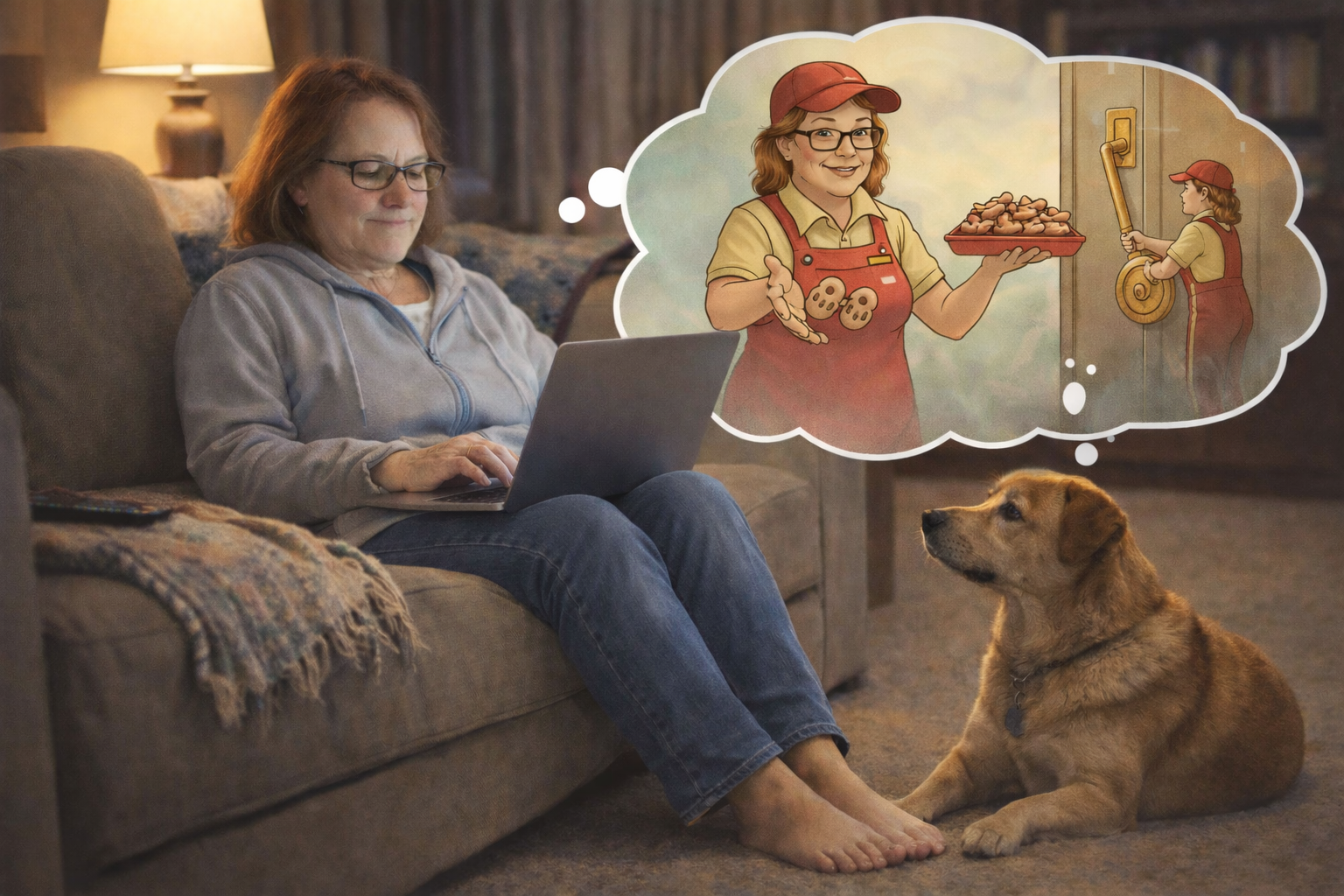
The first time it occurs to you that your pet has absolutely no idea what you do for a living, it’s hard not to laugh. You leave the house for hours, return smelling like a dozen unfamiliar places, and then settle into a routine that, from their perspective, makes very little sense. Yet within that confusion, they form a theory. And once you start paying attention, it becomes clear: your pet is quietly, confidently wrong about your job.
What they see is not your career. What they see is behavior. Repetition. Patterns. And from that, they construct something far simpler, far more immediate—and, in its own way, far more revealing.
The Working Theory
For most dogs and cats, the evidence suggests a narrow but consistent conclusion: you are employed in a series of small, highly specific roles, none of which require leaving the house, and all of which revolve around them.
You are, first and foremost, a food technician. You approach cabinets with purpose. You open containers that produce meals. You operate the sacred devices that deliver kibble, treats, or something better—something from the mysterious realm of “human food,” which appears rarely but carries enormous importance.
You are also a door operator. Doors are complicated. They separate inside from outside, and their function is not always clear. Sometimes they must be opened immediately. Sometimes they must be opened and then closed again within seconds. Your pet has observed that you possess exclusive control over this system, and that you are, at best, inconsistently responsive to requests.
There is also the matter of your station at the glowing rectangle. Whether it’s a laptop, tablet, or phone, this object absorbs your attention for long stretches. You sit, you stare, you occasionally make small noises or movements. From the outside, it resembles work—but it produces no visible food, no walks, no immediate benefit. It is, in your pet’s model, a baffling and likely unnecessary task.
And yet you persist in it, day after day.
The Confusion Points
The biggest flaw in your pet’s understanding is the part where you leave.
From their perspective, this is the most illogical behavior you exhibit. You depart without them, often at predictable times, and remain gone for hours. When you return, you carry with you an entire world of unfamiliar scents—other animals, other people, places they have never seen.
If your job is food, doors, and general presence, then why would you abandon your post?
Some pets resolve this by assuming your absence is part of a larger, invisible duty. Perhaps you are gathering resources. Perhaps you are engaging in some distant version of the same work you perform at home. Others simply register it as a recurring error—an unfortunate but consistent lapse in judgment.
Cats, in particular, may interpret your departure as a failure to understand your role entirely. They do not attempt to correct you. They simply wait, confident that you will eventually return and resume your proper function.
Dogs tend to be more forgiving, though no less perplexed. They greet your return with enthusiasm, not because they understand where you’ve been, but because, finally, you are back where you belong: within range.
Moments of Clarity
Despite the confusion, there are moments when your behavior aligns perfectly with your pet’s expectations. These are the moments that reinforce their theory and make everything else seem like an anomaly.
The sound of a bag opening, for instance, is a defining event. It suggests progress in your primary occupation. You are, at last, doing your job correctly. Your pet becomes alert, focused, present. Whatever else you’ve been doing—typing, pacing, leaving the house—fades in importance.
Sitting down on the couch is another key signal. This is when you become most useful. Your presence stabilizes. Your movements slow. You are available, in a way that matches your pet’s understanding of how things should be.
Bedtime, too, represents a kind of peak performance. The household settles. The lights dim. You assume a fixed position for an extended period. For many pets, this is the closest you come to fulfilling your role completely: staying still, staying nearby, and creating a shared space of quiet.
In these moments, your pet’s model of the world feels accurate. You are where you should be. You are doing what you should do.
The Quiet Radius
Perhaps the most telling aspect of your pet’s interpretation is not what they think you do, but how they position themselves in relation to it.
They do not always sit on you. They do not always demand attention. Instead, they maintain a distance—close, but not intrusive. A few feet away. Within sight. Within hearing. Within what might be described as an invisible boundary of awareness.
This is the working distance of their understanding.
From here, they can monitor your activity. They can respond if something changes—a movement toward the kitchen, the shift of a posture, the subtle cues that suggest a transition from one “job” to another. They are not passive observers. They are engaged, quietly tracking your behavior as part of a shared environment.
It is not about control. It is about connection.
What They Get Right
For all the inaccuracies in their conclusions, pets often arrive at something fundamentally true.
They do not measure your value in output, productivity, or external success. They do not understand your deadlines, your meetings, your obligations beyond the home. These things, while central to your own sense of purpose, are invisible to them.
What they do understand is presence.
You are the one who returns. The one who sits. The one who creates a consistent, predictable rhythm in their world. Your “job,” as they see it, is not something you do elsewhere. It is something you are, here.
In that sense, their model is not entirely wrong. It is simply stripped down to what matters most in the space you share.
You provide food. You open doors. You occupy a place in their daily life that is stable and reliable. Everything else—your real work, your responsibilities, your concerns—exists outside that frame.
And perhaps that is why their version of your job feels so strangely appealing. It reduces a complicated life into something simpler, more immediate, more grounded in the present moment.
You may not be a food technician or a door operator in any formal sense. But in the quiet logic of your pet’s world, those roles are not trivial. They are essential.
========
Calvin R. Densmore is a freelance writer who focuses on everyday observations, human-animal relationships, and the unnoticed patterns of domestic life. His work explores how small, familiar moments reveal larger truths about how we live. This article was written, in part, utilizing AI tools.






Comments