California hits milestone in electric vehicle sales
Published in Automotive News
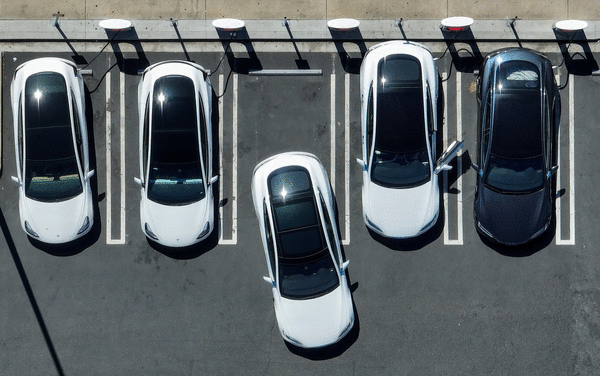
In 2012, when there were about 30,000 electric vehicles on the road statewide in California, Tesla was a small new company that mostly appealed to hobbyists, and the Toyota Prius was still a rarely seen novelty in many areas, former Gov. Jerry Brown signed an executive order setting an audacious goal: 1.5 million EVs sold statewide by 2025.
There were lots of skeptics, given that Brown was calling for a 50-fold increase in the status quo. But as it turned out, California achieved it easily.
With the final sales numbers tallied for 2025, more than 2.5 million electric vehicles have been sold in California since 2012, according to new data released Tuesday by the California Energy Commission.
“We invested in this future when others said it was impossible,” Gov. Gavin Newsom said in a statement.
Newsom highlighted the number — 2,551,121, to be exact — during his appearance Tuesday at the World Economic Forum in Davos, Switzerland.
For the past two decades, California has led the nation in electric vehicle sales. The state has provided rebates, tax credits and other incentives as part of its efforts to reduce air pollution and greenhouse gases.
As the technology has improved, allowing much farther battery range — the Tesla Model Y currently travels more than 300 miles on a charge — EV sales have grown to where they now make up 22.9% of all new car sales in California. Santa Clara County has the highest rate of any county in the state, with 41.1% of all new vehicles sold being electric in 2025.
But electric vehicles are facing major headwinds. During the past year, President Trump has reversed or blocked many of the federal incentives that were put in place by former President Biden.
This past year, Trump and Republicans in Congress eliminated the federal tax credit of up to $7,500 for the purchase of new electric vehicles. They let a law expire that allowed states to permit solo EV drivers to drive in carpool lanes on federally funded highways, ending that perk nationwide.
And in June, Trump signed a resolution blocking California’s first-in-the-nation regulations to ban the sale of new gasoline-powered passenger vehicles statewide in 2035, which Newsom had put in place three years earlier.
Trump held a White House ceremony June 12, saying California’s rules limited consumer choice. He revoked federal permission, called “a waiver,” that the U.S. Environmental Protection Agency had given to California last year when President Biden was in office.
“We officially rescue the U.S. auto industry from destruction by terminating the California electric vehicle mandate once and for all,” Trump said. “They said it couldn’t be done. It’s had us tied in knots for years. They passed these crazy rules.”
Republicans said California’s rules were overly broad and would effectively set a national standard because California is the largest car market in the United States and under the Clean Air Act, other states are allowed to copy its rules.
Environmental groups and Democratic leaders said Trump’s rollbacks will lead to more air pollution, greenhouse gas emissions and health problems for Californian residents.
Newsom and Attorney General Rob Bonta filed a lawsuit over the issue minutes after Trump acted. California was joined by 10 other states — Colorado, Delaware, Massachusetts, New Jersey, New Mexico, New York, Oregon, Rhode Island, Vermont, and Washington. The lawsuit is still pending.
During the fourth quarter of 2025, Californians bought 79,066 new EVs, which represented 18.9% of new car sales. That was a big drop off from the third quarter when EVs accounted for 29.1% of new car sales statewide. Experts and industry analysts noted a surge in EV sales in the weeks before Sept. 30, when the federal tax credits expired.
Even though two of the top three highest-selling vehicles of any kind in California last year were the Telsa Model Y and the Model 3, the other being the Toyota Camry, Tesla has seen some softening of sales in California. Some residents of the famously blue state, angry that Tesla CEO Elon Musk contributed $250 million to Trump’s re-election campaign and led an effort called DOGE to scour federal agencies and reduce staffing through firings and early retirements, have resisted buying Teslas, put stickers on them denouncing Musk, or purchased other EVs, like Hyundais, Hondas, or Rivians instead.
Trump marked his first year anniversary of taking office Tuesday for his second term. The fight over electric vehicle rules stands as one of the major environmental clashes between his administration and California, the other being Trump’s proposal to allow new offshore oil drilling along the state’s coastline.
Trump tried to curb California’s electric vehicle rules and allow new offshore oil drilling in his first term from 2017 to 2021. But California sued in both cases, the lawsuits were still pending when Biden took office, and Biden reversed Trump’s positions.
On Tuesday, Newsom, who is considering a run for president in 2028, cast Trump’s resistance to electric vehicles as putting the United States at a competitive disadvantage in a world where Europe, Japan, Canada, China, and other countries have passed similar laws to encourage the sale of electric vehicles, reduce oil consumption, and phase out the sale of new gasoline-powered cars by 2035 or 2040.
“While Washington now cedes the global clean vehicle market to China, California is ensuring American workers and manufacturers can compete and win in the industries that will define this century,” Newsom said Tuesday.
Two weeks ago, when he released his proposed state budget, Newsom included $200 million for a new electric vehicle rebate program. The plan still needs approval from state lawmakers. Details, including how much motorists will get, which cars are eligible, and what income limits may apply, have not yet been drawn up.
“California isn’t slowing down, we’re still leading the pack,” said California Air Resources Board Chair Lauren Sanchez. “It’s not just about clean air, it’s smart economic policy.”
©#YR@ MediaNews Group, Inc. Visit at mercurynews.com. Distributed by Tribune Content Agency, LLC.






Comments