Trump vows to hit Iran's ships as Hormuz blockade takes effect
Published in News & Features
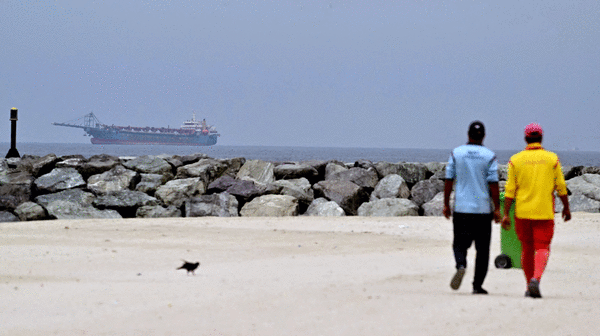
WASHINGTON — President Donald Trump said the United States would attack any Iranian vessels that approach U.S. ships in the Strait of Hormuz, as his naval blockade of the vital waterway took effect Monday.
“Warning: If any of these ships come anywhere close to our BLOCKADE, they will be immediately ELIMINATED,” Trump said in a social media post. He said the U.S. would use the same tactics it did against alleged drug-running boats in the Caribbean Sea in recent months.
Trump’s blockade will test the durability of a fragile ceasefire with Iran and intensifies a global energy crisis in a six-week war that’s seen thousands of deaths across the region. It marks the latest move by the U.S. president to strong-arm Iran into easing its own chokehold over the strait after talks in Pakistan on extending the ceasefire failed to reach a deal.
Oil prices soared as investors braced for further supply shortages if the U.S. blockade curtails the flow of Iranian oil to global markets. Prices remained choppy, though, as trading costs have surged, in turn sapping liquidity. Brent crude traded near $102 per barrel while May U.S. crude futures traded near $103 a barrel by 11:52 a.m. in New York.
Iran has said it would target all ports in the Persian Gulf if its own shipping hubs are threatened, setting up a fresh standoff in waters that typically see flows of about a fifth of the world’s oil and liquefied natural gas.
The security of ports in the region is “either for everyone or for no one,” Iran’s armed forces said in a statement Monday, according to the state-run IRIB News. The U.S. blocking the strait would be “an act of piracy,” it said, reiterating plans to permanently control the critical waterway even after the war.
Shortly before the deadline, the U.S. published a notice to vessels in the region saying that it would intercept, divert or capture vessels leaving Iran after that time. The note said that neutral ships that haven’t called at Iran would not be impeded, though they may be searched for contraband cargo.
The U.S. blockade will be “enforced impartially against vessels of all nations entering or departing Iranian ports and coastal areas,” according to a Sunday statement from U.S. Central Command, which said U.S. forces would not impede vessels transiting Hormuz to and from non-Iranian ports.
A United Kingdom naval group that liaises between the military and shipping said it had been informed of the restrictions and added that additional guidelines, including routing, verification and authorized transit procedures were being developed.
The negotiations in Islamabad broke down due to differences over the future of Iran’s nuclear program, according to U.S. officials. Neither side has committed to another round of negotiations. Iran has countered that the U.S. failed to earn its trust in talks.
“The U.S. must learn: you can’t dictate terms to Iran,” Iran’s former foreign minister, Mohammad Javad Zarif, posted on X. “It’s not too late to learn.”
While the United States and Israel have paused the bombing of Iran — and Tehran has in turn stopped firing missiles at Gulf states — Israel has maintained its invasion of Lebanon to target Hezbollah, a Tehran-backed militant group.
That ongoing offensive, which the Lebanese government says has killed more than 2,000 people, was a bone of contention while the terms of the U.S.-Iran ceasefire struck last week were being ironed out. Talks between Israel and the Lebanese government — which has long pledged to disarm Hezbollah without success — are set to take place this week.
The U.S.-Iran two-week ceasefire agreement is set to expire April 22, if the U.S. blockade doesn’t lead to its collapse before then.
_____
(With assistance from Laura Davison, Devika Krishna Kumar and John Bowker.)
_____
©2026 Bloomberg L.P. Visit bloomberg.com. Distributed by Tribune Content Agency, LLC.





Comments