Swalwell faces bipartisan push to expel him from the House
Published in Political News
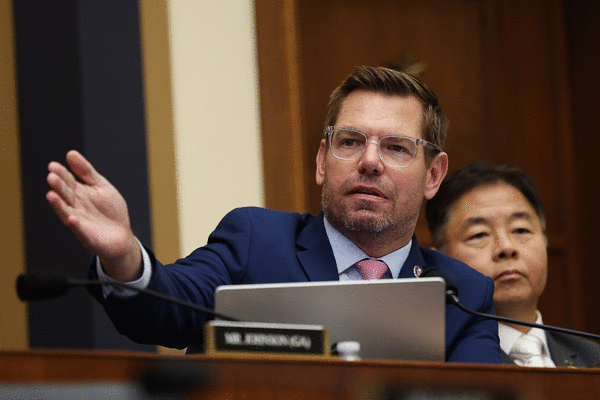
WASHINGTON — The sexual assault allegations that toppled Rep. Eric Swalwell’s bid for California governor are now threatening to end his congressional career with lawmakers from both parties saying they would back a vote to expel him from the House.
Swalwell dropped out of the California gubernatorial primary Sunday night after accusations of sexual assault and misconduct by a former staffer and other women doomed his campaign and drove away his closest allies. Swalwell, who has denied the accusations, has not said whether he intends to resign his House seat.
But the allegations, details in reports by the San Francisco Chronicle and CNN, have drawn swift bipartisan condemnation, with lawmakers calling the accusations “disgusting” and demanding that Congress hold him accountable by removing him from office.
Rep. Anna Paulina Luna, R-Fla., is leading the charge to expel Swalwell. In an interview Monday, Luna said she plans to file a motion as early as Tuesday on the grounds that he violated House rules over an alleged inappropriate sexual relationship with a subordinate. A vote could be forced as early as Wednesday, she said.
Democrats have called on Swalwell to resign, but when it comes to expulsion, they won’t move against Swalwell alone. They are also pushing to expel Rep. Tony Gonzalez, R-Texas, who last month admitted to a sexual relationship with a staffer who later died by suicide. Luna thinks there’s enough support to get both done.
“I think we absolutely have the votes to expel them both,” Luna said in an interview Monday morning. “If we don’t hold out own parties accountable, it’s a poor reflection on us as a whole.”
Rep. Teresa Leger Fernandez, a Democrat from New Mexico, said she will support the motion to expel Swalwell and introduce the motion to push out Gonzalez.
“As I’ve said, Gonzalez and Swalwell are not fit to serve in Congress given their sexual transgressions against women who work for them,” Fernandez wrote on X on Sunday. “They should resign or be expelled.”
If successful, the the expulsions would be the first in congressional history on the grounds of sexual misconduct, and among the rare instances in the House’s 237-year history in which members have expelled their own.
Only six members have been expelled from the House. Three of them were fighting for the Confederacy, two were convicted of bribery and one was the fraudster George Santos, whose sentence was later commuted by President Donald Trump.
Longtime ethics expert Meredith McGehee said that members have been reluctant to expel their colleagues in recent years because of the razor-thin majorities in the House, but that not doing so hurts the credibility of the institution.
“It’s really important at this moment that the House act to expel these men who have been seriously and credibly accused of wrongdoing,” said McGehee, a former executive director of the ethics watchdog Issue One. “To allow either one of them to stay in office and serve out their term would be a farce.”
The Swalwell scandal could prompt an ever larger surge of expulsion calls. Some lawmakers are calling for two additional members to be swept into any expulsion vote: Rep. Cory Mills, R-Fla., who has been accused of sexual assault, and Rep. Sheila Cherfilous-McCormick, D-Fla., who was indicted on charges that she laundered $5 million of federal disaster money and used it to fund a political campaign.
“Reps. Swalwell, Gonzales, Cherfilus-McCormick, and Mills should resign. If they refuse, they should be expelled,” Rep. Nydia Velazquez, D-N.Y., wrote on X Monday. “Americans deserve better and Congress must hold our members accountable.”
Any expulsion would require a two-thirds majority vote, or 290 of 435 votes if every House member participates.
It remains to be seen whether that threshold can be met.
In the meantime, the House Ethics Committee said Monday it has opened an investigation into the misconduct allegations against Swalwell.
In a statement, the Republican-led committee said it will look into whether Swalwell “violated the Code of Official Conduct or any law, rule, regulation, or other applicable standard of conduct in the performance of his duties or the discharge of his responsibilities, with respect to allegations that he may have engaged in sexual misconduct, including towards an employee working under his supervision.”
The committee’s statement added that “the mere fact that it is investigating these allegations, and publicly disclosing its review, does not itself indicate that any violation has occurred.”
©2026 Los Angeles Times. Visit at latimes.com. Distributed by Tribune Content Agency, LLC.



















































Comments