Commentary: Congress and Trump could both get behind this concrete step to cut housing costs
Published in Op Eds
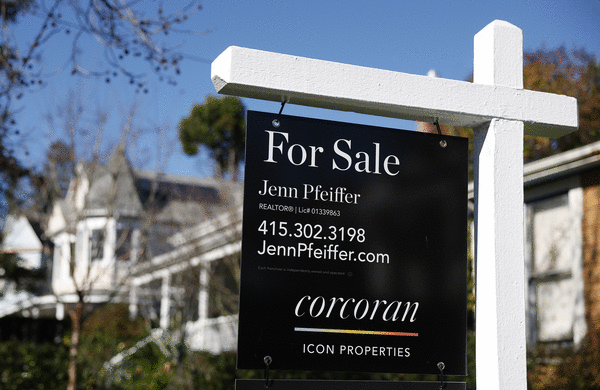
Nearly 70% of American adults polled recently said that the central promise of the American Dream — that hard work can earn a good life — is no longer true or never was.
It’s easy to understand why. Decades of policy choices, rising costs and stagnant wages have eroded the path that once led from work to security. An affordability crisis is continuing to hammer working- and middle-class Americans, making it harder than ever for many just to get by. At the center of this squeeze is housing — the cornerstone of the American Dream.
Home prices are 50% higher today than they were only five years ago — and Americans’ paychecks have not grown to match. Young people, in particular, have been left out in the cold: The average age of first-time home buyers has climbed to 40, the highest on record.
A number of ideas have been floated to address this crisis, including a ban on large institutional investors scooping up private homes — an approach put forward by congressional Democrats multiple times in recent years and raised anew by President Donald Trump earlier this month. Some of these ideas have merit; others do not. But nearly all would take years to implement.
What if there were already a program on the books that could help solve the problem right now?
At the Small Business Administration, where I once served as the deputy and acting administrator, a little-known initiative called the Home Disaster Loan program has been in operation since the 1960s, providing long-term home loans at a low, fixed interest rate for people whose homes or businesses have been damaged by natural disasters. These loans have served as a lifeline for Americans experiencing disasters, and versions of this program have been expanded during broader moments of crisis, including in the early days of the COVID-19 pandemic. Americans today are in a crisis of affordability — so why not expand the program to reach them?
Congress could amend the Disaster Loan program and instantly drop mortgage rates by about 2.25 percentage points, to about 4%, for millions of Americans. For a roughly typical home buyer — seeking a $500,000 house, and making an 18% down payment — this simple change would cut the monthly mortgage payment to $1,950 from $2,450, saving about $6,000 a year.
Crucially, this would not impose a major burden on taxpayers. In 2024, the Home Disaster Loan program issued about 18,000 loans, with interest rates subsidized to allow homeowners and businesses to borrow at the same rate the government does. The program costs about $1 billion to operate, a relatively small portion of the Small Business Administration’s budget. And because taxpayers are on the hook only for the cost of defaults, even a major expansion of the program wouldn’t create a serious cost burden relative to the widespread benefits that would come from cooling off the housing market.
To help mitigate those costs, Congress should maintain the program’s current cap: The loans aren’t available for homes over $500,000. The agency already has strong underwriting standards that ensure that loans go to dependable borrowers, not the subprime candidates whom some past government lending supported. Loans should also be made available to the many current homeowners who would love to buy a new house, but who are inadvertently keeping the housing market frozen because they feel trapped in starter homes they bought at favorable rates.
Would this one quick fix solve the housing crisis? Of course not. But by lowering the financial barrier to homeownership for many, it could help take the pressure off the housing market in much the same way America did a century ago with the advent of the 30-year mortgage — a simple innovation that helped lift homeownership from under half of American families to nearly two-thirds. The policy change I am proposing could bring about a similar effect on a smaller scale: cooling prices, eliminating volatility by replacing constantly shifting interest rates with a friendly and stable option, and opening the door for more Americans to own their own home.
The president’s recent openness to cracking down on high home prices — an issue long popular with Democrats — suggests that there may be a political opening for Congress and the White House to get something done.
If done right, this would ease housing costs while serving nearly everyone’s interests. It serves traditional liberal values by helping raise the standard of living of working Americans. It serves traditional conservative values by bringing more stability and less transience to our communities. And at a time when our leaders have struggled to improve affordability, it offers a concrete step in the right direction — one that the president, who prides himself as a builder, may find attractive.
At a time when Americans are losing faith not only in the American Dream but also in the capacity and willingness of our leaders to defend it, expanding the Home Disaster Loan program can be a small part of the antidote: a simple, immediate, tangible, bipartisan action that can improve people’s lives and help restore that dream — today.
____
Fred P. Hochberg was the deputy and acting administrator of the Small Business Administration from 1998 to 2001. He is a former president of the Lillian Vernon Corp.
©2026 Los Angeles Times. Visit at latimes.com. Distributed by Tribune Content Agency, LLC.















































Comments