Trump says new talks with Iran to seek end of Hormuz standoff
Published in News & Features
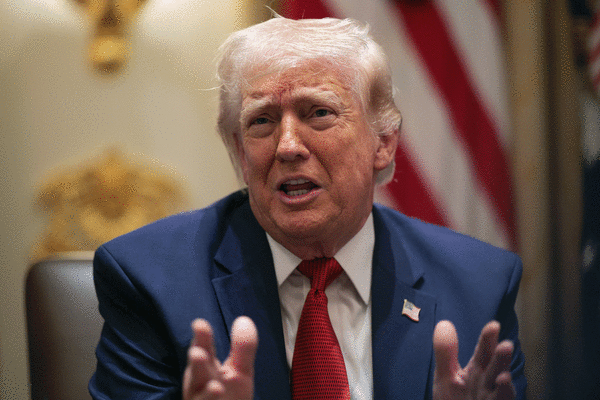
US President Donald Trump promised a quick second round of U.S.-Iran talks in Islamabad this week, while again threatening to strike all power plants and bridges in the country if the negotiations fail.
Iran was noncommittal about joining any talks, with the semi-official Tasnim news agency reporting the Islamic Republic would not attend as long as the U.S. Navy blockade, which started last Monday outside the Strait of Hormuz, was in place. Tasnim said messages were still being passed through intermediaries.
“We’re offering a very fair and reasonable DEAL, and I hope they take it because, if they don’t, the United States is going to knock out every single Power Plant, and every single Bridge, in Iran,” Trump said in a social media post early Sunday. “NO MORE MR. NICE GUY!”
Vice President JD Vance, special envoy Steve Witkoff and the president’s son-in-law Jared Kushner will head to Islamabad Monday night for talks on Tuesday, a White House official said.
The shaky ceasefire between the U.S. and Iran ends on Tuesday. The Joint Maritime Information Center, an international group that shares information about shipping routes, reported multiple attacks by Iranian forces on vessels in the strait as well as the presence of mines and said the overall risk level was “critical.”
Mike Waltz, the U.S. ambassador to the United Nations, said on CBS’ "Face the Nation" that the second round of talks would be a continuation of the terms that Vance presented last week.
The announcement came after Iran reversed its decision and closed the strait, even firing on some ships that tried to transit the strategic waterway.
The standoff over Hormuz — through which about a fifth of the world’s oil and liquefied natural gas flowed before the U.S.-Israeli war on Iran began — threatens to deepen the global energy crisis and is undermining Trump’s weekend prediction of a quick end to the war.
The waterway is just one of the unresolved issues, as well as Iran’s nuclear capabilities and Israel’s ongoing invasion of Lebanon. Trump has said Iran has agreed to end its nuclear program, but Iran has disputed that.
“Ships are awaiting instructions from Iran’s armed forces to determine whether they can pass through the route,” Iran’s semi-official Mehr news agency reported on Sunday.
Still, late Saturday, Iran’s Parliament Speaker Mohammad Bagher Ghalibaf — who led the Iranian delegation in talks with the US earlier this month in Pakistan — said that while gaps “remain significant,” the negotiations are making progress. He added that Iran’s armed forces are prepared to act even as discussions take place.
The U.S. naval blockade is allowing ships carrying non-Iranian cargo to depart the Persian Gulf but not any ships that left Iranian ports, which led to the Islamic Republic re-closing the strait.
“It is impossible for others to pass through the Strait of Hormuz while we cannot,” Ghalibaf said in a televised address.
Meanwhile, the U.S. military is preparing to board Iran-linked oil tankers and seize commercial ships in international waters in the coming days to pressure Iran into reopening Hormuz, the Wall Street Journal reported Saturday, citing anonymous American officials. The White House didn’t respond to a request for comment about the Journal’s reporting.
The Islamic Revolutionary Guard Corps’ navy issued a statement Saturday afternoon warning vessels not to leave their anchorages in the Persian Gulf and the Sea of Oman, and that approaching the strait “will be considered cooperation with the enemy, and the violating vessel will be targeted.”
“They wanted to close up the strait again like they’ve been doing for years and they can’t blackmail us,” Trump told reporters Saturday about Iran, although the strait was fully open until the U.S. and Israel began their bombing campaign seven weeks ago.
Whiplash
The developments of the last 72 hours illustrate the erratic nature of the war and the diplomacy around ending it, with Trump making contradictory statements within hours, Israel continuing to fight in Lebanon and the Iranians opening and closing the Strait of Hormuz.
Trump on Friday said a deal with Iran was all but agreed to, including concessions Tehran has never publicly made, signaling he was ready to sign and move on to domestic issues. He even told ABC News that he trusted the Iranians, a group whose civilization he just recently threatened to wipe out.
And early Sunday, Trump said Vance would skip the talks for “security reasons,” with the White House noting shortly after that Vance would in fact attend and “things change,” according to CNN.
There were also signs the ceasefire in Lebanon — linked to Iran’s decision to allow Hormuz traffic — may be fraying. The Israel Defense Forces said it struck “saboteurs” approaching its troops in violation of the truce, and one Israeli soldier was killed and three wounded.
Momentum for a lasting peace had been building late last week, but cracks began to emerge Saturday with Iran’s criticism of the continued U.S. blockade.
The U.K. Navy soon after said a tanker was approached by IRGC gunboats before being fired at, adding that the targeted vessel and its crew were safe. A container ship was hit by an unknown projectile in a separate incident off the coast of Oman, it said. And India said its ships were also fired upon.
Iran’s Supreme Leader Mojtaba Khamenei said the country’s “navy stands ready to make enemies taste the bitterness of new defeats” in a statement marking National Army Day. It wasn’t clear whether his message was in direct response to developments surrounding Hormuz.
Iran is in control of the strait and will secure its rights “either at the negotiating table or in the field,” Iranian First Vice-President Mohammad Reza Aref said, according to the semi-official Mehr news agency.
Oil, fuel and natural gas prices plunged Friday on hopes that the latest developments would mean an end to the war and more energy supplies could transit safely through Hormuz. Brent crude dropped 9% on Friday to around $90 a barrel. Diesel prices in the U.S. and Europe also fell.
_____
(With assistance from Eltaf Najafizada, Dan Williams, Weilun Soon, Sara Gharaibeh, Omar Tamo, Valentine Baldassari and Patrick Sykes.)
_____
©2026 Bloomberg L.P. Visit bloomberg.com. Distributed by Tribune Content Agency, LLC.





Comments