Billions of birds are on their way to Minnesota as migration season begins
Published in News & Features
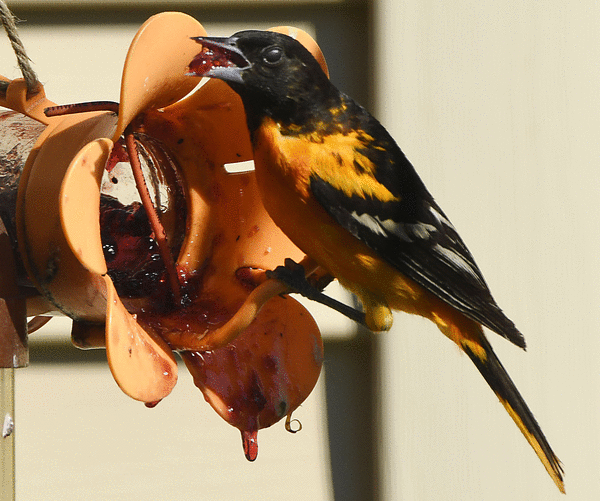
MINNEAPOLIS — Here it comes, the annual flood of migratory birds returning to their summer homes across Minnesota, or even farther north. At this time of year, billions of birds are on the move, from South America, Central America and the southern U.S. They have two things on their minds: arriving early enough to stake out a rich nesting territory and attracting a quality mate.
Just as the early robin gets the worm, the earliest returnees have the widest choices. Birds who start their journeys late or who dally along the way aren’t going to have as wide a pool of mates and nesting territories to choose from. This is critical for male birds seeking to pass on their genes to a new generation.
Birds that left Minnesota last autumn — 75% of our state’s bird species — began lifting off from winter homes as early as February. They don’t fly in a nonstop marathon for the most part — instead they dash, then rest, dash, then rest, intent on arriving back near where they spent last summer. The resting and refueling stops along the way help ensure they’re in peak condition when they arrive, with enough energy and strength to immediately begin to compete in the breeding sweepstakes.
Two very different bird species help illustrate the complexity of spring migration, as different species face off to claim different habitats.
The Baltimore oriole, with its high-contrast black and orange feathers, and the ruby-throated hummingbird, with its iridescent coat and flashing red throats (on males) will soon arrive. Both these beautiful and charismatic species have large and enthusiastic human fan clubs.
Orioles mainly eat insects and fruit, while hummingbirds hunt for nectar and tiny insects. When both species departed last fall, they were motivated not by the coming cold but by the disappearance of their food sources.
Orioles return as caterpillars are hatching out on tree leaves. I listen for their sweet melodic whistles high in trees around my local lakeshore in early May each year. Their migration period extends through May, with a peak in mid-May.
Many people set out grape jelly and orange slices and hang nectar feeders to tide orioles over until the fruits and berries they relish ripen later in the season.
Hummingbirds are on a similar schedule, zipping in to claim a territory from late April to early June, peaking in mid-May. Nectar-loving hummingbirds arrive before most plants are in bloom to offer high-energy nectar. So, these tiny birds do something so unusual it sounds like an old wives’ tale: Hummingbirds follow yellow-bellied sapsuckers drilling wells in tree bark to catch flowing sap. The sap has about the same sugar content as flower nectar and attracts small insects. These will tide hummingbirds over as they wait for early flowering plants.
Songbirds may fly hundreds of miles each night and rely on their superb navigational skills to end up close to the area they left last fall. When people talk about “my hummingbird is back,” or “my oriole is here,” they’re telling the truth. An oriole that spent the winter in Panama ends up flying thousands of miles before its journey is completed. And a ruby-throated hummingbird may depart the Yucatan, flying 500 miles nonstop across the Gulf of Mexico, before continuing northward.
The minute they arrive on nesting grounds, the race is on to establish territory boundaries and find a mate. Females then build a nest, lay eggs, incubate them and set fledglings on their way to adulthood. Orioles nest just once each season but hummingbirds turn right around after their first twins fledge and start another nest, raising a second set of nestlings.
Springtime songbird migrants share similar stories. Rose-breasted grosbeaks, indigo buntings, gray catbirds and the family of warblers all make the journey. Part of the migration scenario is hard-wired into their brains, some they learn as they go.
Migration is an awe-inspiring spectacle, performed by small, feathered beings who may weigh less than an ounce. They’ll be dropping down into backyards, wetlands, grasslands and forests any day now. To get the most out of their arrival, I suggest the following tools:
©2026 The Minnesota Star Tribune. Visit at startribune.com. Distributed by Tribune Content Agency, LLC.






Comments