Could state voting rights be the next vehicle for Maryland redistricting?
Published in News & Features
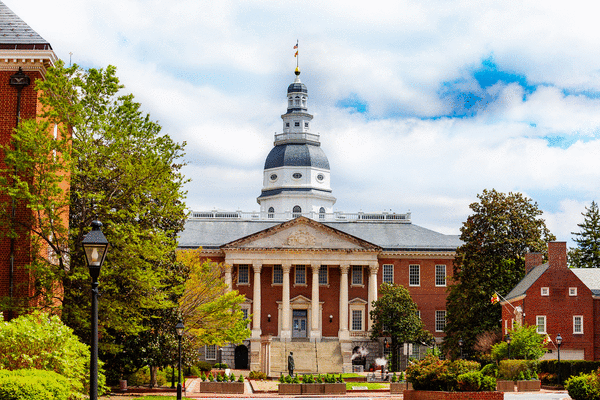
BALTIMORE — Maryland lawmakers passed a voting rights bill in the final days of the 2026 legislative session that could give Gov. Wes Moore a new path to revisit congressional redistricting — despite failing to win approval to redraw maps during the session.
“What is happening at the local level could be an attempt to see what would be possible at the state level,” Niambi Carter, a professor at the University of Maryland’s School of Public Policy, said.
The House of Delegates, over the weekend, passed voting rights legislation intended to ban all counties and local municipalities from practicing vote dilution in elections. The measure was introduced as an emergency bill in both chambers. The Senate passed its version of the bill in February. Now that it’s passed both chambers, it will be enacted into law immediately after Moore signs it.
Analysts and lawmakers remain divided over whether its scope could extend beyond local governance or be leveraged in Moore’s redistricting fight.
Supporters of the bill said that the practice denies minority voters the power to elect political candidates of their collective interests — a point similar to one Moore made as he advocated redrawing Maryland’s maps. Democrats noted that enacting voting rights legislation was essential to combat voter suppression, like when the Baltimore County Council in 2025 proposed creating only two majority-Black districts as it sought to expand its bench from seven to nine members; meanwhile, people of color make up nearly half of the county’s population.
Still, political analysts said that a future redistricting push, building off of Maryland’s voting rights act, would have “less to do with thinking about or prioritizing the needs of voters of color or Black voters in particular, and more about the kind of message that Wes Moore’s administration and our state legislature might want to send the Trump administration,” Carter said.
Mark Graber, a constitutional law professor at the University of Maryland’s Carey School of Law, said the voting law’s language “doesn’t appear” to justify redistricting, but said that “in contemporary politics, who knows anything can justify anything?”
At a news conference Monday, Moore highlighted his commitment to ensuring Maryland’s maps are redrawn to earn Democrats an extra seat in the state’s congressional delegation to Washington. Redistricting “is not an issue that is done or settled, because Donald Trump continues to show this issue is (neither) done nor settled,” Moore said.
The Baltimore Sun asked Moore’s office whether the newly passed voting measure is Moore’s redistricting “Plan B” he previously mentioned after the Senate refused to consider redistricting. The governor’s office didn’t respond to multiple requests for comment.
Maryland’s latest push to enact its own voting protections comes as the Supreme Court weighs a challenge to the federal Voting Rights Act. The state joins several others that have enacted similar measures, including New York, Connecticut and Virginia.
This is the fourth time the Maryland General Assembly has considered this legislation, titled the “Voting Rights Act of 2026 — Counties and Municipal Corporations,” underscoring Democrats’ agency in recent years to counter federal legal actions that have scaled back voter protections across the country and limited voters’ access to the polls.
If Maryland’s voter protections become law, the state attorney general could also sue jurisdictions if they identify vote dilution in areas where candidate choices don’t match minority voters’ preferences, but favor majority voters’ inclinations, according to the bill’s fiscal and policy note.
The legislation reflects an ongoing, broader national debate on how elections should be accessible and fair, and acknowledge local government authority. During a nearly two-hour Saturday floor debate, Maryland House Democrats alleged that vote dilution at the county and municipal level has disenfranchised voters of color and cost them political leadership. Republicans countered, noting issues relating to voter suppression can’t be legislated so hastily, and state decisions on election systems would strip local jurisdictions of a say in their own elections.
Delegate Greg Wims, lead sponsor of the House bill, said that voter protections allowed Black voters to elect people like him, citing his decadeslong work to expand civil rights. But, he told the Sun, his bill has nothing to do with redistricting and he “won’t even support anything we redistricting off of this bill” should the Democratic apparatus use the legislation to parlay into redistricting talk.
Del. Kris Fair, one of several co-sponsors of the bill, said, “The Voting Rights Act really is designed to live inside of its own shell by itself.”
Republicans have called Democrats hypocritical in their advocacy for minority voters, given that Democrats’ redistricting push would eliminate Maryland’s lone majority-Republican district, costing Republican voters much-needed representation in Maryland’s federal delegation. But they don’t see voting rights legislation as the vehicle for redrawing the state’s maps.
“The arguments they’ve made are that racial minorities — some of whom may in fact be majorities in particular communities — are underrepresented in county governments,” House Minority Leader Jason Buckel said in a text to the Sun. “Democrats in general are in fact overrepresented at the congressional level.”
_____
©2026 Baltimore Sun. Visit baltimoresun.com. Distributed by Tribune Content Agency, LLC.





Comments