Army Corps, DeSantis announce accelerated plan for Everglades restoration
Published in News & Features
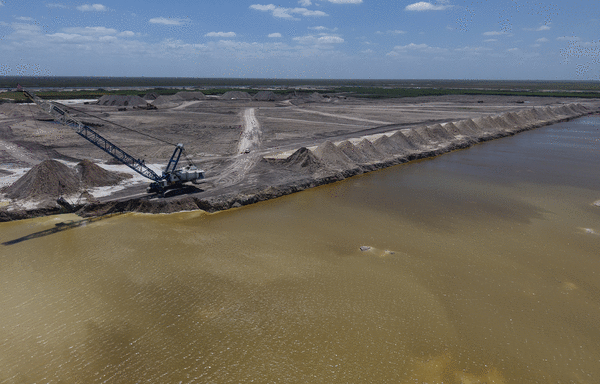
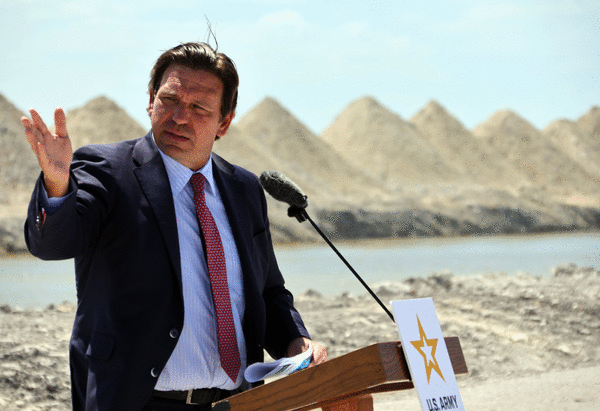

The U.S. Army Corps of Engineers announced Monday that they will accelerate the plan for completing the reservoir known as the “crown jewel” of Everglades restoration.
The new plan moves the projected completion of the Everglades Agricultural Area Reservoir up by five years, from 2034 to 2029.
“We’ve taken on one of the most ambitious ecosystem restoration projects in the world, and we’ve agreed to do it faster,” said Gen. Jason Kelly, of the Army Corps. “The Army has challenged us to complete the Everglades Agricultural Area Reservoir by Dec. 31, 2029. … We’re not waiting. We’re moving,” he said at a news conference at the South Bay, Florida, construction site.
Gov. Ron DeSantis hinted at the accelerated schedule last November, when the state took over construction of a pump station that would move water from Lake Okeechobee into the eventual EAA Reservoir.
Included in the 2029 completion deadline is 6,500 acres of engineered wetlands, known as stormwater treatment areas, that will clear Lake Okeechobee water before sending it south into the Everglades, and the pump station, which the state is building.
The reservoir sits mainly above ground level, and will have 37-foot-tall earthen retaining walls, allowing for a 23-foot water depth.
Once completed, the 10,500-acre EAA Reservoir will store store excess water from Lake Okeechobee that was previously shunted through canals to the east and west coast, where it damaged both the Caloosahatchee and St. Lucie River estuaries and local economies. The discharge often resulted in blooms of sometimes-toxic blue-green algae and seagrass die-offs.
The build is part of the $23 billion Comprehensive Everglades Restoration Plan (also known as CERP), which was passed by Congress in 2000 and involves dozens of projects to restore water flow to a more natural state across the southern tier of Florida.
Twentieth-century construction of canals and levees divided and drained the Everglades, flooding some areas, such as the Miccosukee Reservation, while leaving other areas dry, and causing high salinity levels in Florida Bay.
Kelly said a completed CERP will restore flow across 1.5 million acres of wilderness and reduce damaging discharges to the St. Lucie and Caloosahatchee estuaries by up to 80%.
“It will strengthen the resilience of a system that serves 9 million people, providing water supply, flood protection and economic stability for a state whose economy depends on a healthy Everglades.”
Gov. Ron DeSantis said the accelerated schedule was made possible by an increase in state and federal spending, and by the state taking over responsibility for key projects, including the aforementioned pump station and the Blue Shanty Flow Way, which will move water south of Tamiami Trail and toward Florida Bay.
These three maps represent historic Everglades flow, altered flow and the eventual restore flow once the Comprehensive Everglades Plan is complete. (Everglades Foundation)“We’ve dedicated $8 billion over the past seven years for Everglades restoration and water quality improvements,” said DeSantis. “That’s a massive, massive increase of what Florida had been doing prior to that.”
_____
©2026 South Florida Sun Sentinel. Visit at sun-sentinel.com. Distributed by Tribune Content Agency, LLC.






Comments