Illinois bill would force gunmakers to redesign pistols that can be converted to automatic weapons
Published in News & Features
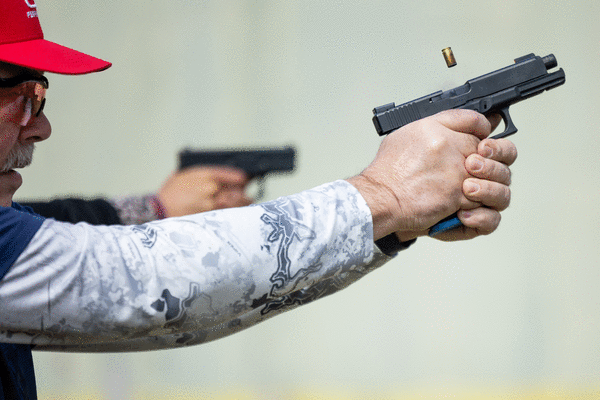
SPRINGFIELD, Ill. — Three years after Illinois passed a sweeping assault weapons ban in the wake of Highland Park’s Fourth of July mass shooting, state lawmakers are weighing another measure aimed at the firearms industry: requiring some gun manufacturers to redesign pistols so they can’t be easily converted into automatic weapons.
The latest effort by Illinois, long a national leader on gun control, mirrors legislation California passed last year and comes as lawmakers in New York, Connecticut and Maryland consider similar bills.
While supporters say the proposal would make it harder for criminals to obtain fully automatic firepower, gun rights advocates are already lining up to counter that it unfairly punishes manufacturers for the actions of people who illegally modify weapons.
The legislation focuses largely on Glock-style pistols, said Alison Shih, senior counsel for Everytown for Gun Safety. Compared with other brands, Glocks and similarly designed firearms are particularly prone to being manipulated with machine gun conversion devices, also known as “switches” or “auto-sears” — small devices attached to the back of handguns that transform them into automatic weapons. With “15 minutes and common household tools,” Shih said, a person can convert a semiautomatic pistol into one capable of firing multiple rounds with a single pull of the trigger.
Though the switches or auto-sears used to help convert pistols to automatic weapons are already illegal to own under state and federal law, Shih said they can still be purchased overseas or produced with 3D printers using designs readily available online.
“It’s a pretty minor adjustment for them to make,” Shih said.
“It is really akin to being like ‘Please put some seat belts in your car before you sell the vehicle,’” she said of the proposed legislation. “We know this can save lives and sometimes industry needs a little bit of a nudge.”
National Rifle Association spokesperson Justin Davis said the gun industry shouldn’t be responsible for the illegal activity of others.
“Criminals will always find a work-around; they’re always going to find a way to do criminal activity, and forcing Glock or any other industry company to change their designs is outrageous,” Davis said.
In addition to Glock, pistols with a cruciform trigger bar — including the Palmetto State Armory Dagger and the Ruger RXM — would need to be redesigned, according to Everytown spokesperson Isabel Aptman. Most major manufacturers, including Smith & Wesson and Taurus, would not be affected because their designs are more difficult to modify.
The proposal would not require Illinois residents who already own such firearms to give them up. Manufacturers and gun shops could sell existing inventory to licensed out-of-state buyers or to those exempt from the ban, including prison officials, nuclear facility security personnel, members of the state or federal National Guard and current and former law enforcement officers.
Fred Lutger, owner of Freddie Bear Sports gun shop in Tinley Park, said Glock weapons are some of his “better sellers” and described the proposed legislation as another attempt by Illinois lawmakers to restrict gun rights rather than address crime.
“We suffer every time they make another law against guns,” Lutger said. “They need to go after the criminal element that picks up these guns and uses them in an illegal manner. It’s not the gun that’s doing illegal things.”
The city of Chicago sued Glock in 2024, alleging the manufacturer’s Austrian parent company knowingly ignored a design flaw in its pistols that allowed simple modifications to fire automatic rounds. Chicago police officers recover thousands of illegal firearms every year, and Glock is by far the most common make of weapon. Between January and November 2025, more than a third of all guns recovered by the Chicago Police Department — nearly 2,900 — were manufactured by Glock, according to CPD data analyzed by the Tribune.
The city’s ongoing lawsuit points to the proliferation of machine gun conversion devices used on semiautomatic pistols. Last September, a Cook County judge ordered that the still-pending lawsuit could proceed. In a 17-page order, Judge Allen Walker wrote that “a reasonable jury could determine that the design and manufacture of a Glock pistol by Glock Inc., its subsequent sale by (two suburban gun stores), materially contribute to a condition in the City of Chicago that endangers the safety and health of the public.”
The next hearing in the case is scheduled for Thursday, court records show. Other cities and states, such as Minnesota, Maryland, Baltimore, Seattle and New Jersey, have also filed similar lawsuits against Glock.
Kathleen Sances, CEO and president of the Gun Violence Prevention PAC, said gun manufacturers such as Glock should be working to help prevent gun violence and that the legislation would push them to act.
“It absolutely should be their responsibility,” Sances said. “And they should also be held liable for the destruction that their product … does to devastate communities. Every other consumer product, those manufacturers are held liable, but not guns.”
Glock discontinued its pistol model late last year and replaced the plastic nub near the rear sight with a small steel rail in its new pistol models, known as Gen V, to solve the conversion issue. However, the redesign did little to prevent modification as videos soon circulated showing modified versions of the new models firing automatically.
Officials with Glock did not respond to multiple requests for comment.
“It’s not just an Illinois thing. All over the country, we’re seeing more and more use of these switches turning semi-automatic handguns into fully automatic. And so it’s something that we want to prioritize,” said Rep. Justin Slaughter, a Chicago Democrat and the bill’s chief sponsor.
Illinois State Rifle Association Executive Director Richard Pearson said legislation like this could create a burdensome and costly game of Whac-A-Mole where gun manufacturers need to continually tweak their designs to adapt to the behavior of criminals.
“Almost any firearm … can be converted to fire automatic rounds,” Pearson said. “It shifts the burden of people’s illegal actions back to the corporations and companies that make things.”
Illinois Democrats, who control the governor’s office and both chambers of the General Assembly, have advanced a series of gun restrictions in recent years. Following the July 4, 2022, shooting in Highland Park that resulted in seven dead and nearly 50 wounded, Illinois passed the 2023 law banning high-capacity magazines, auto sears and more than 100 types of semiautomatic rifles, handguns and shotguns. The measure is facing multiple legal challenges, including from President Donald Trump’s administration.
In 2024, the U.S. Supreme Court declined to take up a challenge to a lower court decision allowing the ban to remain in effect while litigation proceeds, but Justice Clarence Thomas wrote that the high court should accept the full case if it comes back for review and expressed deep reservations about the constitutionality of what he called Illinois’ “highly suspect” ban.
Lawmakers are also considering other proposals against the firearms industry. One would require ammunition to be serialized and tracked in a police database. Another would create new manufacturing permits, with fees directed to a state fund to support medical care, recovery and long-term services for victims of gun violence and their families.
---------
—Tribune reporter Sam Charles contributed.
____
©2026 Chicago Tribune. Visit at chicagotribune.com. Distributed by Tribune Content Agency, LLC.






Comments