Bill calls for 'surfing reserves' off California's coast to protect from threats
Published in News & Features
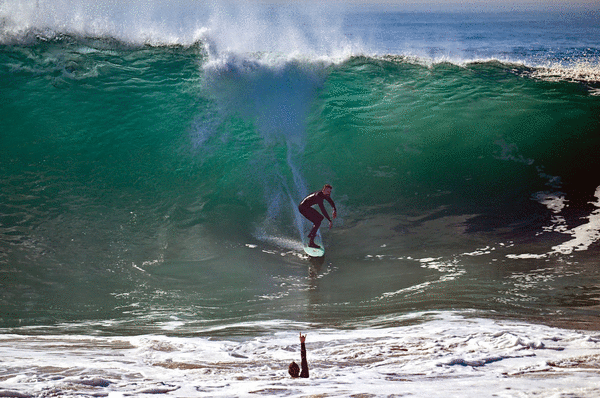
LOS ANGELES — California’s coastline is dotted with world-class surf breaks — from the iconic Malibu that helped fuel the culture and popularity of the sport to the monster waves at Mavericks in Northern California that test elite big wave surfers to Lower Trestles, the site of the LA28 Olympics — and proposed legislation could protect them.
A bill authored by Assembly member Jacqui Irwin, D-Thousand Oaks, would designate state surfing reserves using the California Coastal Act of 1976, which aims at giving protections for coastal areas from development and ensuring public access.
Irwin notes that the coastline spans 1,100 miles, and the state is home to a number of world-famous surf breaks.
“These breaks are destinations for millions of domestic and international surfers, and generate several billion dollars of economic activity every year,” she said in a statement. “While the state is a leader in ocean conservation, California does not have a policy framework designed to specifically protect surf resources, which are all the natural resources and conditions that work together to create surfable waves.”
The Ocean Protection Council would oversee the effort, working with local governments, which would adopt a formal resolution and apply for the designation, providing a description of the surfing reserve. Local governments would also be tasked with promoting and publicizing the reserve through signs.
The bill, known as AB1938, would require, on or before July 1, 2027, that a criteria and an application process be created to designate an area of the coastline as a state surfing reserve. And, the Ocean Protection Council would be required to include designated surfing reserves in the state’s 30×30 goal — established by Gov. Gavin Newsom in 2020 — to conserve 30% of California’s lands and coastal waters by 2030.
The 30×30 goal is intended to help conserve natural areas through voluntary, collaborative action with partners across the state to meet three objectives: conserving and restoring biodiversity; expanding access to nature; and mitigating and building resilience to climate change.
A “surfing reserve” would be an area that features waves, surf zones, and surrounding environments, and would “recognize the surfing area’s environmental, cultural, and historical significance.”
When establishing criteria for purposes of the state surfing reserve designation, factors such as wave quality and consistency, surf culture and history, and environmental characteristics, and management priorities will be important.
In their applications, local governments would need to provide a description of the proposed surfing reserve, including the specific geographic location and coastal access. And there would need to be a description of the cultural, historical, ecological, and economic value of the proposed surfing reserve.
Twice before, the bill failed to make it through the Appropriations Committee, but advocates are hoping a third time is a charm. It recently passed through the Assembly Natural Resources Committee.
Nations such as Australia and New Zealand have conservation measures for endangered surf zones, creating national policies to protect their surf zones.
The designation of high-quality breaks in Australia demonstrated the ability to raise economic growth by 2.2%, bringing in an annual average of $20 million for every region with quality waves nearby, according to the bill’s fact sheet.
Climate change, coastal erosion and pollution are damaging the health and longevity of California’s surfing communities.
“Designating surf reserves will empower local communities to implement conservation measures, improve water quality, and enhance coastal access for generations to come,” the bill says.
The bill touches on a bit of history, back to the 1920s when surfing competitions were established here and “a booming surf culture was created when the automobile became readily accessible, enabling inland individuals to visit the coast.”
“Today, surfing is an iconic California sport, and the state is home to a number of world-famous surf breaks like Malibu, Trestles, Mavericks, Rincon, Steamer Lane, Ocean Beach, and Huntington Beach, which are destinations for both domestic and international surfers,” it says.
Every year, California hosts domestic and international surf events, including the International Surf Festival, the U.S. Open of Surfing, and the Big Wave Surf Contest.
California is also home to the Surfers’ Hall of Fame, Surfing Walk of Fame, the International Surfing Museum, and the California Surf Museum, as well as the birthplace of the commercial surfboard industry and neoprene wetsuits.
The state has an estimated 3.3 million surfers, who spend between $1.9 and $3.3 billion each year on local surf trips,.
Anything that brings local and state officials together to protect California’s economy is a good thing, said Vipe Desai, executive director of the Surf Industry Members Association.
“California has a lot of connectivity to the surf economy,” he said, noting the state’s official sport is surfing. Sept. 20 is also California Surfing Day. “There are some of the best waves in the world in California and the environmental groups based in California are leading the narrative, conversation and advocacy impacting breaks all around the world.”
Professional surfers brought in $140 billion in domestic surf tourism in California in 2018 alone, and the surf industry, which is almost exclusively based in California, generates more than $6 billion in the United States annual retail sales.
The bill mentioned ongoing efforts by the Save the Waves Coalition, a California-based nonprofit that has a goal of protecting 1,000 surf ecosystems by 2030. It’s a program created 15 years ago that “identifies, designates, and preserves outstanding waves, surf zones, and their surrounding environments around the world as World Surfing Reserves.”
There are 13 designated sites worldwide, with two in California: Santa Cruz and Malibu.
_____
©2026 MediaNews Group, Inc. Visit ocregister.com. Distributed by Tribune Content Agency, LLC.






Comments