UN to Haiti's political leaders: 'Time for political maneuvering is over'
Published in News & Features
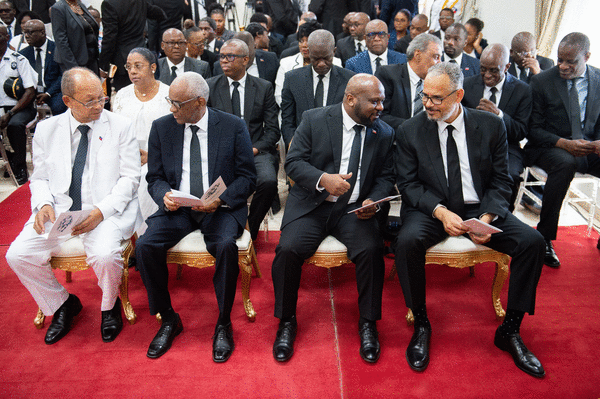
As Haiti approaches the end of another political transition without elections or a clear governing framework, the United Nations and other international partners are warning that political self-interest and infighting could further unravel an already fragile country,
The warning comes as the nine-member Transitional Presidential Council appears to be moving toward ousting yet another prime minister, Alix Didier Fils-Aimé, after failing to reach consensus on how the government should be run after Feb. 7, when the transitional council’s term is scheduled to end.
“We are observing with profound concern that efforts to establish a legitimate transitional government at this juncture have failed to yield concrete results,” Latvia’s representative, Sanita Pavļuta-Deslandes, said during a meeting Wednesday of the United Nations Security Council.
Members of the Security Council made clear that the presidential council’s mandate will end in 18 days. Yet, despite this, members seem poised to remain in office while targeting Fils-Aimé, who is trying to avoid the fate of predecessor Garry Conille, who was also fired by the council.
But unlike Conille, who was fired after six months and lost support from Washington, Fils-Aimé is in a different position. Foreign diplomats in Port-au-Prince have made it clear the council’s days are numbered and that Fils-Aimé, a businessman, must stay on for continuity and to avoid a political vacuum that could further embolden gangs.
“Let’s be clear: the time for political maneuvering is over,” Carlos Ruiz-Massieu, the U.N.’s special representative in Haiti, said as he briefed the Security Council on Haiti’s deteriorating political and security situation. His comments seemed directed squarely at Haitian leaders.
He called for Haiti’s politicians to work to contain political fragmentation, set aside their differences, preserve institutional continuity and focus on organizing elections, which are scheduled for this summer.
“The situation demands that authorities, political parties, civil society, the private sector and community leaders prioritize the national interest and act with responsibility and restraint,” Ruiz-Massieu said.
But restraint appeared in short supply in Port-au-Prince, where residents awoke on Wednesday to burning barricades in several neighborhoods, and where uncertainty over the prime minister’s future fueled fears of renewed instability.
What the presidential council ultimately intends to do remains unclear. The U.S. and others have expressed concern about avoiding a political vacuum after Feb. 7, and few in the international community appear willing to continue backing a transitional entity that has been engulfed by allegations of corruption since coming to power in April 2024, has been accused of ties to armed groups and has failed to deliver on its central task: leading Haiti to elections.
“With the February 7 deadline for democratic transition fast approaching and with no interim solution in sight, we urge all stakeholders to intensify the integration dialogue to agree on new transitional governance arrangement until the holding of elections, leveraging the support of regional organizations and the good offices” of the U.N. Integrated Office in Haiti, Greece’s representative, Aglaia Balta, said.
China’s deputy representative, Geng Shuang, addressed the crisis as well. “The political transition is a means to hold consensus and restore order. It must not become an excuse for procrastination or evading responsibility,” he said. “All Haitian parties and factions must prioritize the nation’s future and the people’s interests.”
The political uncertainty is unfolding against a backdrop of worsening violence, diplomats stressed.
The U.N. reported that more than 8,100 killings were documented nationwide in Haiti last year, a figure it said was likely underreported because of limited access to gang-controlled areas. Those areas not only encompass much of Port-au-Prince, but they’ve spread into rural parts of the Artibonite region and the Central Plateau.
In a report released ahead of the meeting, Secretary General António Guterres said killings had increasingly targeted people suspected of cooperating with police or resisting gang control, while sexual violence — predominantly against women and girls — was being used as a punitive tactic.
“Gangs continued to engage in kidnapping for ransom, extortion and the destruction of property, obstructing access to essential services, including health care and education, exacerbating food insecurity and economic hardship,” he said. “Reports also indicated an increase in the trafficking in children, with children continuing to be used by gangs in multiple roles, including in violent attacks.”
John Brandolino, the acting executive director of the U.N. Office on Drugs and Crime, told the Security Council that criminal groups in Haiti had evolved from fragmented local gangs into structured networks with defined leadership, territorial ambitions and diversified revenue streams.
The crisis, he said, “has grown more violent, more systemic and more embedded.”
Even as rivalries persist between gangs, the armed groups have consolidated into federated coalitions to coordinate their actions, and in some cases now even frame their activities in political language, Brandolino said.
Haiti’s representative to the council, Ericq Pierre, stressed that the authorities were responding.
“The Haitian National Police, with limited resources, is currently gradually retaking control of certain key localities, breaking the hold of criminal gangs over strategic areas,” he said.
Wednesday’s meeting was convened to review the mandate of the U.N. Integrated Office in Haiti, known by its French acronym BINUH, and to assess preparations for a U.N.-backed Gang Suppression Force, which is expected to deploy initial components to Haiti by early April. France said the effort was making “good headway,” but warned that preserving institutional stability would be essential.
_____
©2026 Miami Herald. Visit miamiherald.com. Distributed by Tribune Content Agency, LLC.




Comments